
The Role of String Lights in Holiday Displays: 2026 Guide
Why string lights are the foundation of every holiday display
String lights do more than decorate. They define the mood, signal the season, and turn an ordinary house into something neighbors slow down to look at. Whether you call them Christmas lights, fairy lights, or holiday string lights, their role in holiday displays is to create a visual and emotional experience that no other decoration can replicate on its own.
Here is what string lights actually do in a holiday display:
-
Set the ambiance. Warm white or multicolor light transforms a dark December evening into something inviting and festive.
-
Define the structure. Rooflines, trees, pathways, and mantels all take on intentional shape when outlined with light.
-
Signal community participation. A lit house tells the neighborhood you are part of the celebration.
-
Provide design flexibility. From static warm white to fully animated RGB pixel sequences, string lights adapt to any aesthetic or budget.
-
Extend the display outdoors. Unlike most decorations, string lights work at scale, covering entire facades, trees, and yards.
The importance of holiday lighting goes well beyond aesthetics. Electric Christmas lights transformed the holiday from a private, family observance into a shared public event, and that community dimension is still very much alive in every neighborhood display you see today.
How string lights went from a single tree to a national tradition
The story of holiday string lights in America starts with one engineer and a lot of ambition. In 1882, Edward H. Johnson, a business associate of Thomas Edison, hand-wired 80 red, white, and blue bulbs onto a Christmas tree in his New York home and displayed them in a rotating window. It was the first well-known electric Christmas light display, and it drew immediate public fascination.
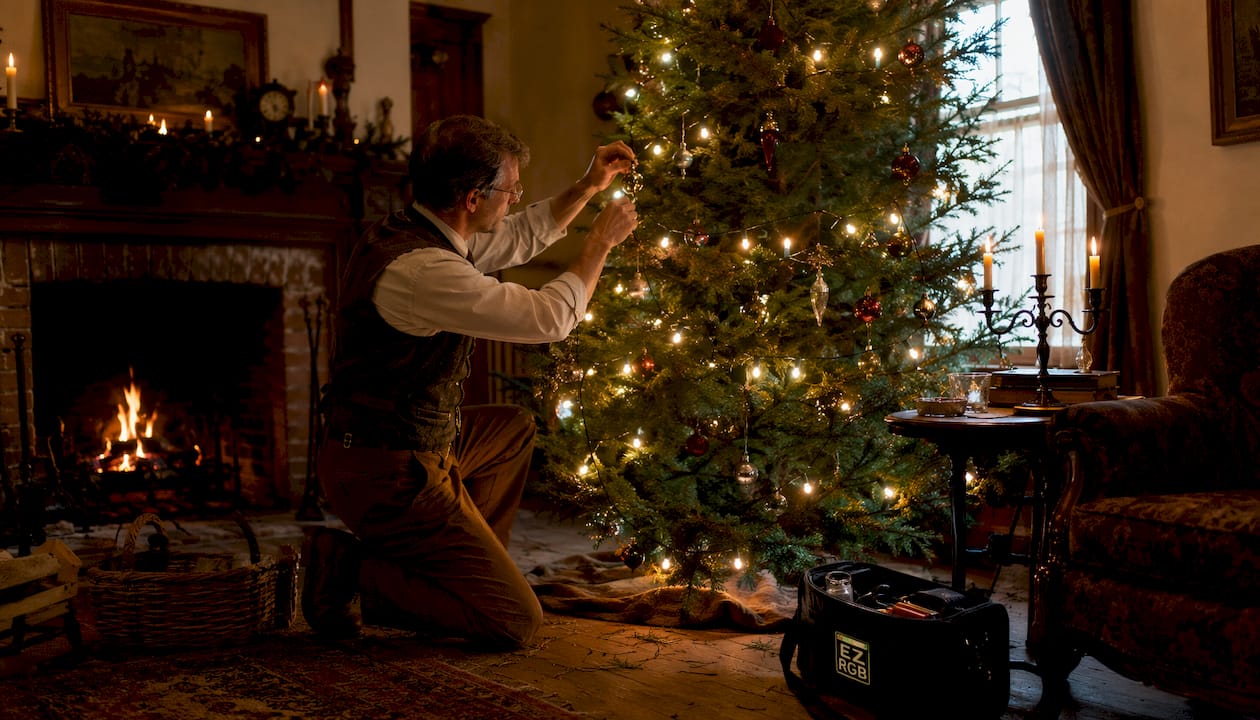
For the next two decades, electric lights remained a luxury. Wiring a tree required hiring a lineman, and the cost put lights out of reach for most families. The shift toward accessibility came in 1903, when General Electric introduced the first pre-wired eight-socket light strings, called festoons, making home installation far safer and simpler. By 1907, the Excelsior company was advertising complete light sets with colored bulbs in red, green, and white.
The outdoor tradition took a distinctly personal turn in 1914. Denver resident D.D. Sturgeon hung electric lights outside a tree as a gesture of comfort for his sick son, and the practice caught on quickly in the neighborhood. By 1919, Denver’s city electrician John Malpiede had begun decorating Civic Center Park, eventually expanding the display to the Greek Amphitheater and the Denver City and County Building.
The timeline below shows how the tradition scaled from a single household gesture to a national custom:
| Year | Milestone |
|---|---|
| 1882 | Edward H. Johnson displays the first electric Christmas tree lights in New York |
| 1903 | GE introduces pre-wired festoon light strings, making home use practical |
| 1914 | D.D. Sturgeon hangs outdoor lights in Denver, sparking a neighborhood tradition |
| 1923 | President Calvin Coolidge lights the White House Christmas tree with 3,000 electric bulbs |
| Post-WWII | Parallel wiring and suburban housing boom make outdoor displays standard across America |
| 1960s | Weatherproof string lights make roofline and eave decoration widespread in tract housing |
Key milestones in the broader adoption of holiday string lights:
-
1900: Retail stores begin stringing lights in windows, turning Christmas lighting into a commercial and cultural signal.
-
1923: President Coolidge’s White House tree lighting with 3,000 electric bulbs gave the tradition a national stage.
-
1925: The Sadacca family formed the National Outfit Manufacturer’s Association (NOMA), which later became NOMA Electric Co., the largest Christmas light producer in the world through the 1960s.
-
Post-WWII: Parallel wiring replaced series wiring, so one burned-out bulb no longer killed the whole string. This reliability change made large outdoor displays practical for the first time.
-
1960s onward: The suburban housing boom and affordable weatherproof sets turned roofline lighting into a neighborhood norm across America.
Today, more than 150 million light sets are sold in America each year, with more than 80 million homes decorated with holiday lights.
What types of string lights actually power today’s holiday displays
Not all string lights are built the same, and the technology you choose determines what your display can do. Three main categories define the current market: incandescent, LED, and addressable pixel lights.
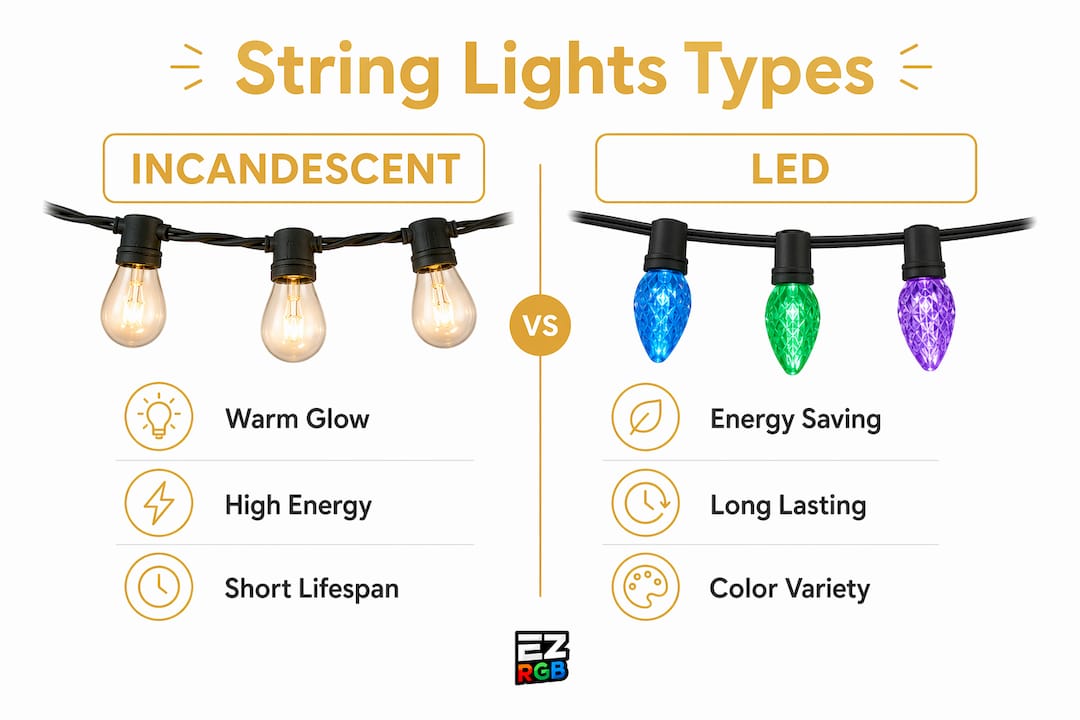
Incandescent vs. LED is the most fundamental choice. Incandescent bulbs produce warm, familiar light but consume considerably more energy and burn out faster. LED holiday lights use far less energy, last much longer, and require less maintenance over a season. Colored LEDs are also more efficient at producing saturated color than incandescent bulbs coated with translucent paint.
The comparison below covers the practical differences decorators care about most:
| Feature | Incandescent | Standard LED | Addressable Pixel LED |
|---|---|---|---|
| Energy use | High | Low | Low to moderate |
| Lifespan | Shorter | Much longer | Much longer |
| Color control | Fixed color per bulb | Fixed or per string | Independent per node (16 million colors) |
| Animation capability | Limited (flasher bulbs) | Limited effects | Full per-pixel control |
| Weatherproofing | Varies | Varies | IP68-rated options available |
| Best for | Classic, budget displays | Energy-efficient static displays | Animated, programmable shows |
Standard RGB vs. addressable pixel is where decorators often get confused. Standard RGB lights change the entire string to one color at a time. Addressable pixel technology controls each node independently, which means you can run chases, waves, and complex color patterns across your display simultaneously. That independent control is what makes animated sequences possible.
Commercial-grade vs. retail-grade matters more than most decorators realize. Retail-grade sets often fail after one or two seasons because moisture gets into the connectors. Commercial-grade products use IP68-rated waterproof connectors and fully encased nodes, which hold up across multiple seasons outdoors without constant replacement.
Controllers add another layer of capability. Modern lighting controllers support synchronized animation, dimming, and music-sync effects, turning a static display into a timed show. Software platforms like EZRGB let you program individual pixel sequences, while using the cloud-based system to handle the sequencing automatically. You can explore plug-and-play holiday light options that remove most of the technical setup entirely.
How string lights shape the mood and meaning of holiday celebrations
The effects of string lights go beyond decoration. They carry cultural weight that has built up over more than a century of American holiday tradition.
Electric Christmas lights shifted the holiday from intimate family observances into community-wide celebrations, accessible to people across income levels and backgrounds. A lit house in a neighborhood is a form of participation, a visible statement that says you are part of something shared. That dynamic is why post-9/11 Christmas displays in 2001 took on a distinctly patriotic character, echoing the home-front light displays of World War II.
The cultural reach of holiday lighting is also reflected in its sheer scale. Holiday lights consume about 6% of the U.S. electrical load in December, a figure that underscores just how deeply the tradition is embedded in American life.
What string lights do for ambiance and mood:
-
Warm color temperatures (2700K–3000K) create a cozy, welcoming feeling that draws people toward a display rather than past it.
-
Multicolor displays signal celebration and playfulness, working well for family-oriented or community-facing setups.
-
Animated sequences add energy and movement, turning a static display into an event people return to watch.
-
Pathway and perimeter lighting guides visitors and creates a sense of arrival, making a home feel intentionally designed for the season.
-
Layered lighting (combining roofline lights, tree wraps, and accent props) creates depth that flat, single-layer displays cannot achieve.
The secular nature of American Christmas light displays is worth noting. While some decorators use lighting for religious expression, the majority use it to convey warmth, community identity, and a sense of shared celebration. That broad, inclusive quality is a large part of why the tradition has spread well beyond Christian households and into a genuinely national custom.
Holiday lights consume a notable share of the U.S. electrical load in December, making them one of the more energy-intensive seasonal traditions in the country and a strong argument for switching to LED technology.
How to use string lights effectively in your holiday display
Good holiday decor with lights comes down to placement, layering, and knowing which type of light fits each location. Here is how to approach each element of your display.
Popular placement spots and what works best in each:
-
Rooflines and eaves: C9 or C7 bulbs on commercial-grade cords hold up to weather and provide the bold outline that reads from a distance. Space them evenly and use clips rated for outdoor use.
-
Trees (outdoor): Wrap from the trunk outward to the branch tips for even coverage. Pixel lights let you animate the tree independently from the rest of your display.
-
Pathways and driveways: Stake lights or low-voltage LED strings define the approach to your home and add depth to the overall display.
-
Windows and doors: Fairy lights or warm white mini-lights frame architectural features without competing with larger outdoor elements.
-
Mantels and indoor spaces: Battery-powered fairy lights give you placement flexibility without running cords across the room.
Design tips for color and layering:
Stick to two or three colors for a cohesive look. Warm white as a base with one accent color (red, blue, or green) tends to read more intentionally than a mix of every available color. If you are using pixel lights, you can change the color palette for each holiday without reinstalling anything.
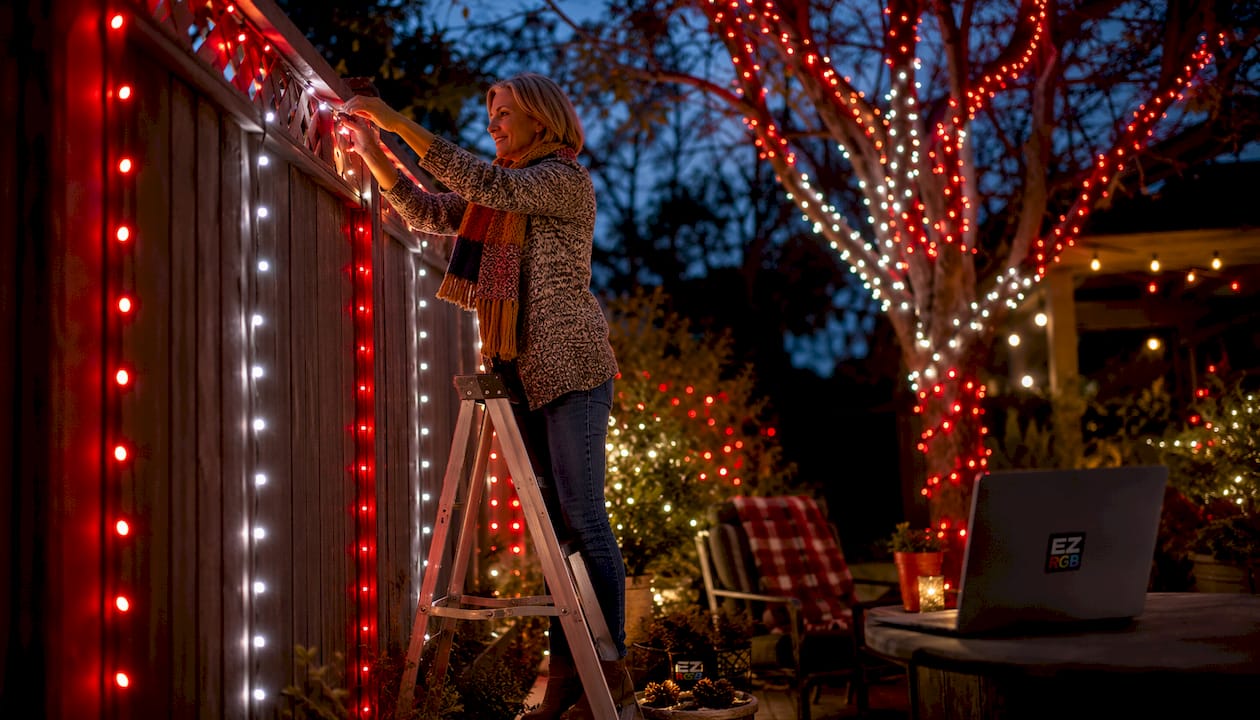
Layering means combining different light types at different heights. Roofline lights at the top, tree wraps at mid-level, and pathway lights at ground level create a display with visual structure rather than a flat wash of light.
Pro Tip: Before installing outdoor lights, check that every set is rated for outdoor use. The UL (Underwriters Laboratories) listing on the packaging will specify “outdoor” or “indoor/outdoor.” Using indoor-rated lights outside is a fire and shock hazard, regardless of how mild the weather seems.
Maintenance and troubleshooting basics:
-
Test all strings before installing them. A dead string discovered after it is stapled to the roofline costs twice the time to fix.
-
Store lights loosely coiled or on a reel to prevent tangling and connector damage.
-
For pixel lights, check controller connections first when a section goes dark. Loose data connections are the most common cause of partial failures.
-
Replace damaged cords rather than taping them. Outdoor electrical tape degrades quickly in cold and wet conditions.
For detailed guidance on keeping your display running safely all season, the EZRGB product care guide covers maintenance steps for pixel-based systems specifically.
How modern innovations are changing what holiday displays can do
The biggest shift in holiday lighting over the past decade is the move from seasonal to permanent, programmable systems. Permanent RGB lighting systems with programmable LEDs let you run a Christmas display in December, switch to red and pink for Valentine’s Day in February, and go green for St. Patrick’s Day in March, all without touching a single fixture. That eliminates the installation and takedown labor that makes traditional holiday decorating so time-consuming.
Addressable pixel technology is the engine behind this flexibility. Because each node is controlled independently, you can run animations, color chases, and music-synchronized sequences that were previously only possible for professional installers with specialized equipment. Pre-programmed lighting effects have made this level of display accessible to homeowners without any programming background.
Key innovations shaping holiday lighting in 2026:
-
Cloud-based sequencing: Your display updates automatically when new sequences are purchased, without requiring you to reprogram anything locally.
-
Drag-and-drop design tools: Platforms like EZRGB let you upload a photo of your home, place props where you want them, and preview the full display before ordering a single light.
-
Music synchronization: Controllers sync light sequences to audio tracks in real time, turning a static display into a timed show that runs on its own schedule.
-
Weatherproof construction: IP68-rated connectors and encased nodes mean a well-built system can stay mounted year-round without degradation.
EZRGB brings all of these capabilities together in one platform. You upload a photo of your home, drag and drop pixel props into position, and the cloud-based system programs your lights to music automatically. The EZPlayer keeps your show connected to the cloud, so sequence updates and new programming arrive without starting over from scratch. The result is a professionally animated holiday display that you can build and adjust without any technical background.
Pro Tip: When planning a pixel display for the first time, start with your roofline and one focal tree. These two elements give you the most visual impact per dollar and let you learn the system before expanding to a full-yard installation.
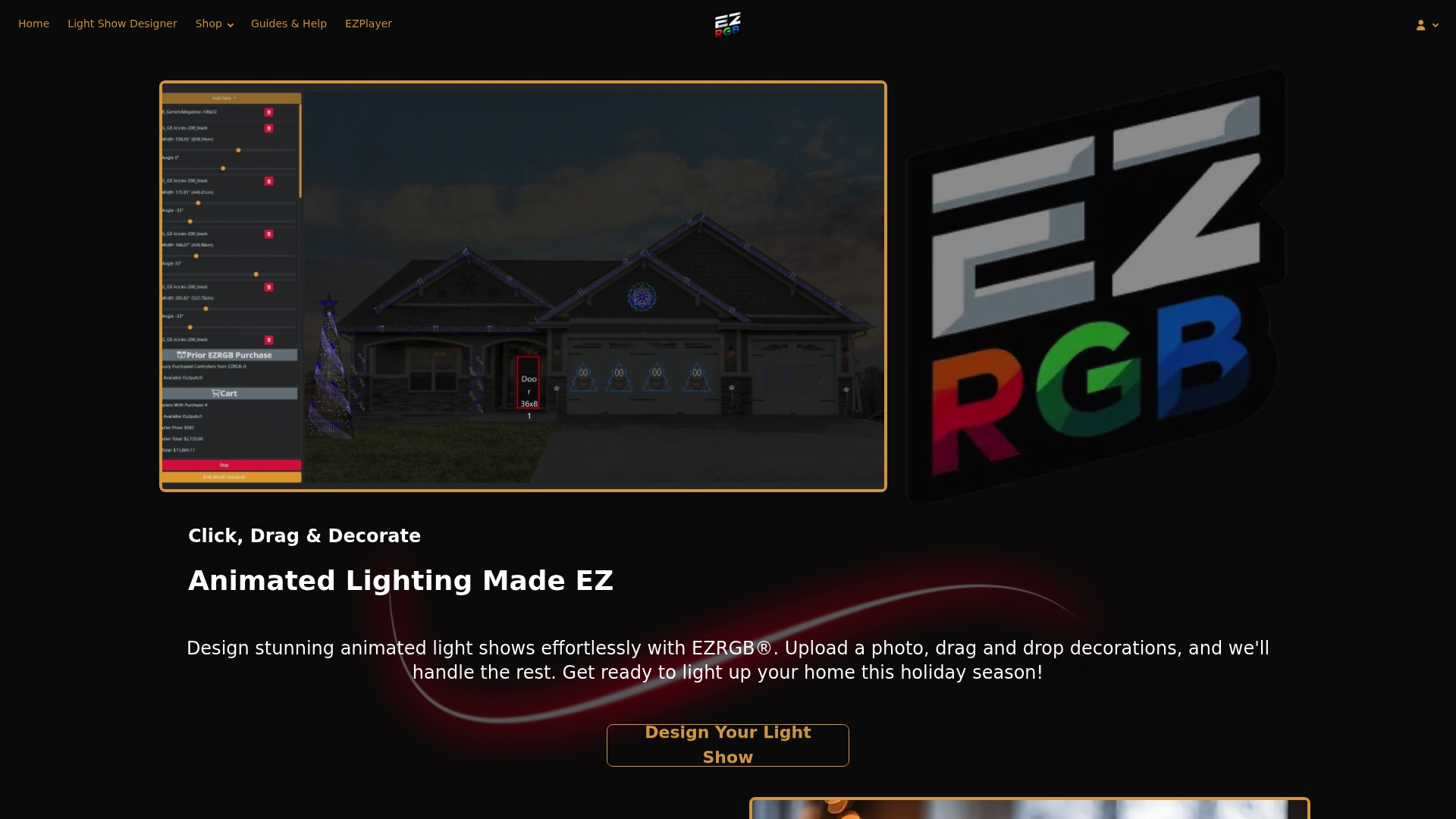
Ready to build your own animated display? EZRGB’s drag-and-drop designer and Christmas light show kits give you everything you need to go from a photo of your home to a fully programmed, music-synced show.
Key Takeaways
String lights are the single most versatile and culturally significant element in any holiday display, and LED pixel technology has made professional-quality animated shows accessible to any homeowner.
| Point | Details |
|---|---|
| Cultural foundation | Electric Christmas lights transformed the holiday from a private observance into a community-wide celebration. |
| Scale of the tradition | More than 150 million light sets are sold in America each year, with over 80 million homes decorated. |
| LED advantage | LED holiday lights use far less energy than incandescent bulbs and last much longer, reducing both cost and waste. |
| Pixel vs. standard RGB | Addressable pixel lights control each node independently, enabling animations impossible with standard RGB strings. |
| Permanent systems | Programmable RGB permanent lighting eliminates seasonal installation labor and adapts to any holiday or event. |
FAQ
Are string lights the same as Christmas lights?
Yes. Christmas lights, fairy lights, festive lights, and string lights all refer to the same product: strands of electric lights used for holiday decoration. The names are used interchangeably across North America.
How do Christmas string lights work?
String lights connect a series of bulbs to a power source through a cord. LED sets use a current-limiting resistor to regulate power to each bulb, while addressable pixel lights add a data line that lets a controller send individual color and brightness instructions to each node.
What are the latest trends in holiday string lighting?
Permanent, programmable RGB pixel systems are the dominant trend in 2026. These systems stay mounted year-round and change color themes for each holiday, eliminating seasonal installation. Music-synchronized animated displays, cloud-based sequencing, and drag-and-drop design tools have made this level of display accessible to homeowners without technical experience.
What is the significance of lights at Christmas?
Christmas lights carry both personal and communal meaning. Historically rooted in the symbolism of light during dark winter months, electric Christmas lights became a way for Americans to express civic pride, community belonging, and shared celebration. The tradition grew from private family displays into a national custom that spans religious and cultural backgrounds.
How much energy do holiday lights use?
Holiday lights account for about 6% of the U.S. electrical load in December. Switching from incandescent to LED strings reduces energy consumption significantly, since LED holiday lights use far less power and last much longer than their incandescent counterparts.